Why AI agents need budgets before they go to production
Why production AI agents need cost limits, workflow ownership, and usage guardrails before they start making tool calls at scale.
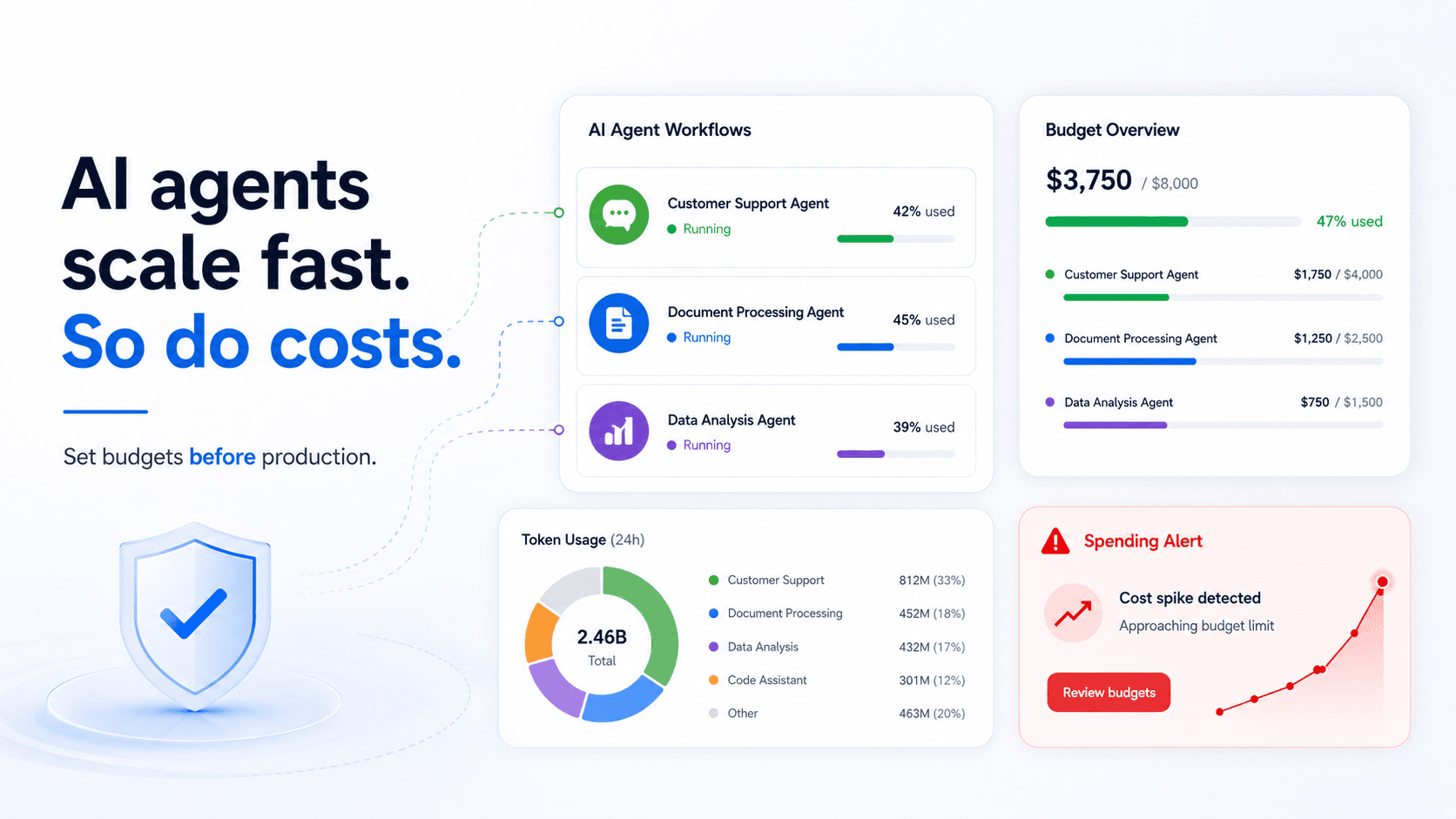
AI agents are moving from experiments to real product workflows. That shift makes budgets a production requirement, because an agent can spend through loops, retries, tool calls, and long context before anyone sees the monthly invoice.
Agents can spend more than teams expect
A traditional AI feature usually has a predictable cost shape: a user sends a request, the system calls a model, and the response comes back. You can estimate the average token cost, latency, and volume with some confidence.
Agents are different. An agent may call a model once, or it may call it twenty times. It may use tools, retry failed steps, search documents, call APIs, summarize results, reflect on its own answer, and continue working until a goal is complete.
Without budgets, every agent workflow becomes an open-ended cost surface.
- Planning calls.
- Tool selection calls.
- Retrieval and summarization calls.
- Retry loops and failed tool calls.
- Background follow-up tasks.
Production agents need guardrails
Monitoring tells you what happened. Budgets help decide what is allowed to happen.
For AI agents, budgets should define clear limits before the workflow starts. That does not mean blocking useful work. It means giving the agent a safe operating boundary.
If a task is valuable enough to exceed the normal limit, that should be an intentional product decision, not an accidental loop.
- Maximum cost per task.
- Maximum number of model calls.
- Maximum tool calls and retry count.
- Maximum runtime and context size.
- Daily or monthly spend limits by workflow.
Cost should connect to outcomes
A simple monthly AI bill does not help an engineering team understand whether an agent is efficient. The better question is what the agent accomplished and what it cost to accomplish it.
This is where budgets become strategic. Instead of asking why the AI bill increased, teams can ask which agent workflows are creating value, which ones are expensive, and which ones need redesign.
That changes the conversation from cost cutting to cost intelligence.
- Cost per resolved support ticket.
- Cost per completed research task.
- Cost per generated report.
- Cost per qualified lead.
- Cost per successful workflow automation.
Agents need budget ownership
Every production agent should have an owner. Not just a technical owner, but a cost owner.
That owner should understand which product workflow the agent supports, which models it uses, which tools it can call, what normal usage looks like, and what should happen when the agent crosses a budget threshold.
Without ownership, agent spend becomes nobody's responsibility until it becomes a finance problem. With ownership, teams can review agent behavior the same way they review infrastructure, database, and cloud costs.
- Workflow and product owner.
- Expected cost per task.
- Allowed models and tools.
- Normal usage volume.
- Alert and hard-stop thresholds.
Budgets improve agent design
Budgets are not only financial controls. They are design feedback.
When an agent keeps exceeding its cost limit, it usually reveals a deeper issue: the prompt is too broad, the agent has too many tools, retrieval is pulling too much context, the retry policy is too aggressive, or the task should be handled by deterministic code.
A budget makes these problems visible early. Without a budget, teams may only notice when spend spikes after the agent is already embedded in customer workflows.
- Reduce unnecessary context.
- Route simpler steps to cheaper models.
- Limit tool access by workflow.
- Add human approval for expensive paths.
- Replace agent behavior with deterministic automation where possible.
What an agent budget should include
A practical AI agent budget should include both financial and behavioral limits. The goal is not to slow teams down. The goal is to make production AI predictable enough to scale.
Teams should track agent name, workflow, owner, environment, model, average cost per task, maximum cost per task, token usage, tool usage, retry count, success rate, failure rate, latency, customer attribution, monthly budget, alert threshold, and hard-stop threshold.
This gives engineering, product, and finance a shared view of how the agent is operating.
The bottom line
AI agents should not go to production with unlimited authority and unclear cost boundaries.
They need budgets the same way cloud infrastructure needs quotas, alerts, and ownership. A good agent budget answers three questions: what is this agent allowed to spend, what value should that spend create, and who owns the decision when it crosses the line.
Budgets are not a blocker to production. They are what make production AI safe to scale.