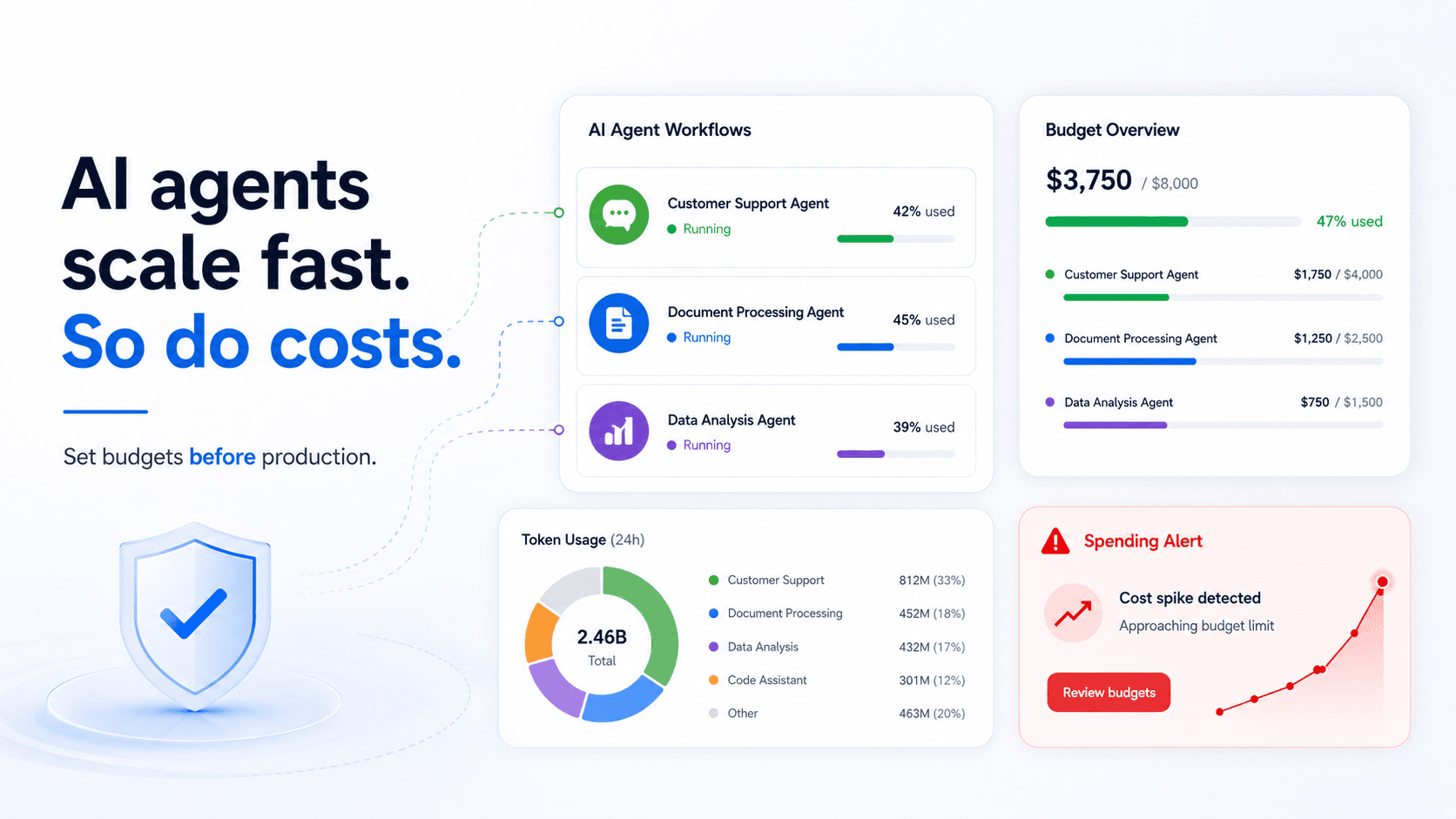
The API key and token management problem growing inside AI teams
Why shared LLM keys are becoming a governance problem, how token usage gets lost across teams, and how OggyCloud gives companies a safer control layer.
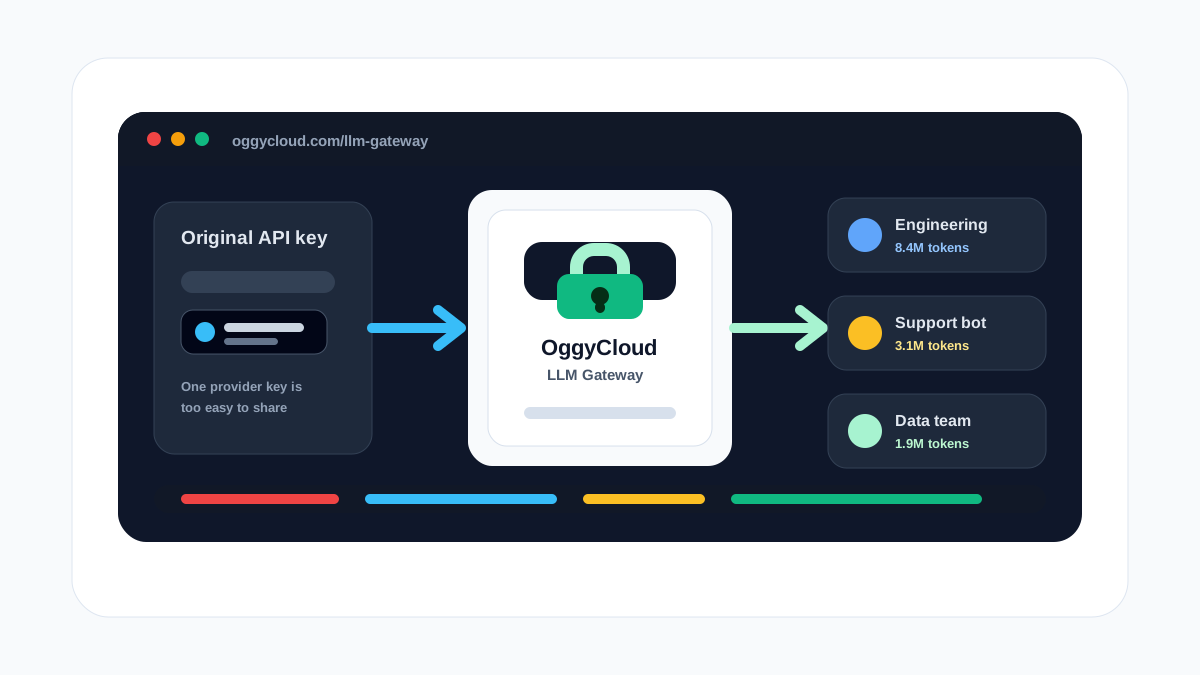
AI adoption is creating a quiet operational problem: one API key gets copied into many scripts, apps, agents, and developer laptops, but the organization still has to answer who used it, what they asked, and what it cost.
The market problem: AI usage is spreading faster than governance
Most teams do not begin with a formal AI platform. They begin with a provider key, a proof of concept, and a few developers trying to move fast. Soon the same key is inside backend services, internal tools, notebooks, customer workflows, experiments, and scheduled jobs.
That creates an attribution gap. Provider dashboards can show total usage, but companies need operating detail: which team created the request, which app triggered it, which model was used, how many input and output tokens were consumed, and whether the prompt should have been logged at all.
This is why LLM usage management now belongs next to LLM token management, OpenAI usage tracking, and broader cloud cost optimization workflows instead of living only inside a provider billing page.
Why shared provider keys break down
A raw provider key is useful for authentication, but it is a weak unit of ownership. If ten people use the same key, the bill does not explain the difference between a production customer workflow, a staging experiment, an evaluation run, or a developer testing prompts locally.
Security teams also lose clean controls. Revoking the key can break every integration at once. Rotating it requires hunting through services. Budgeting it by team is almost impossible without an additional layer in front of the provider.
- No reliable user or team attribution when one key is shared.
- No simple per-workflow budgets or model allowlists.
- Prompt and response logs are either missing or captured without policy.
- Revocation and rotation become operationally risky.
What companies actually need
The right control layer should let the company keep one provider relationship while giving every request a verifiable identity. That identity may represent a person, service, team, environment, or customer-facing feature.
The system should capture metadata by default, with prompt logging as an explicit policy decision. Cost and token data should be usable by engineering, finance, and platform teams without forcing every application to build its own reporting pipeline.
- One place to store provider keys securely.
- One gateway endpoint for OpenAI-compatible traffic.
- Identity and policy on every request.
- Token, cost, latency, and error telemetry by actor, model, and workflow.
The OggyCloud solution
OggyCloud provides a managed LLM gateway and cost intelligence layer. A company connects its OpenAI or other provider key once, then routes application traffic through OggyCloud. The gateway validates identity, applies policy, forwards the request, and records usage.
For teams that do not want to create many API keys, OggyCloud can support a workspace key plus signed actor identity. The workspace key identifies the application or customer workspace. The actor identity identifies the user, team, app, or environment behind the request.
That makes OggyCloud the audit and control plane between AI applications and model providers. The same product direction also connects with the LLM cost calculator and integrations surfaces.
- Store the provider key encrypted.
- Issue a workspace gateway key.
- Attach signed actor identity to each request.
- Enforce IP, model, budget, and rate-limit policy.
- Record token usage, estimated cost, prompt metadata, latency, and errors.
What the dashboard shows
The dashboard turns raw LLM calls into an operating view. Leaders can see top users by tokens, cost by model, failed requests, expensive prompts, workflows crossing budget, and usage trends over time.
Engineering teams get the detail needed to debug and optimize: prompt shape, context size, model selection, retries, latency, and response size. Finance gets spend by owner instead of one blended provider invoice.
- Tokens by user, team, app, and model.
- Cost by workflow and provider.
- Prompt logs with redaction and retention controls.
- Blocked requests by policy reason.
- Alerts for budget, anomaly, and high-cost prompts.
Why this belongs with cloud cost management
LLM spend behaves like infrastructure spend. It is metered, grows with product usage, depends on engineering choices, and can surprise finance when ownership is unclear.
That is why OggyCloud brings AI token telemetry into the same operating model as cloud, SaaS, and platform costs. Teams should be able to review AWS resources, Vercel projects, MongoDB Atlas usage, and OpenAI token consumption in one cost workflow.